A Tech Transfer Starts Long Before the First Batch - And Usually Fails There Too
Ask what went wrong with a difficult technology transfer and the answers usually point at execution - a batch that underperformed, an analytical method that would not qualify, a deviation that consumed six weeks.
Trace those failures back and they tend to originate somewhere less dramatic: a conversation that did not happen early enough.
In a recent BioPharm International discussion on tech transfer, Henning Gerschewski, VP Manufacturing Science and Technology at Rentschler Biopharma, located the start of a successful transfer well before the project itself - in the initial discussions with the client about project goals, needs, scope, and timelines.
Scope is a timeline control, not paperwork
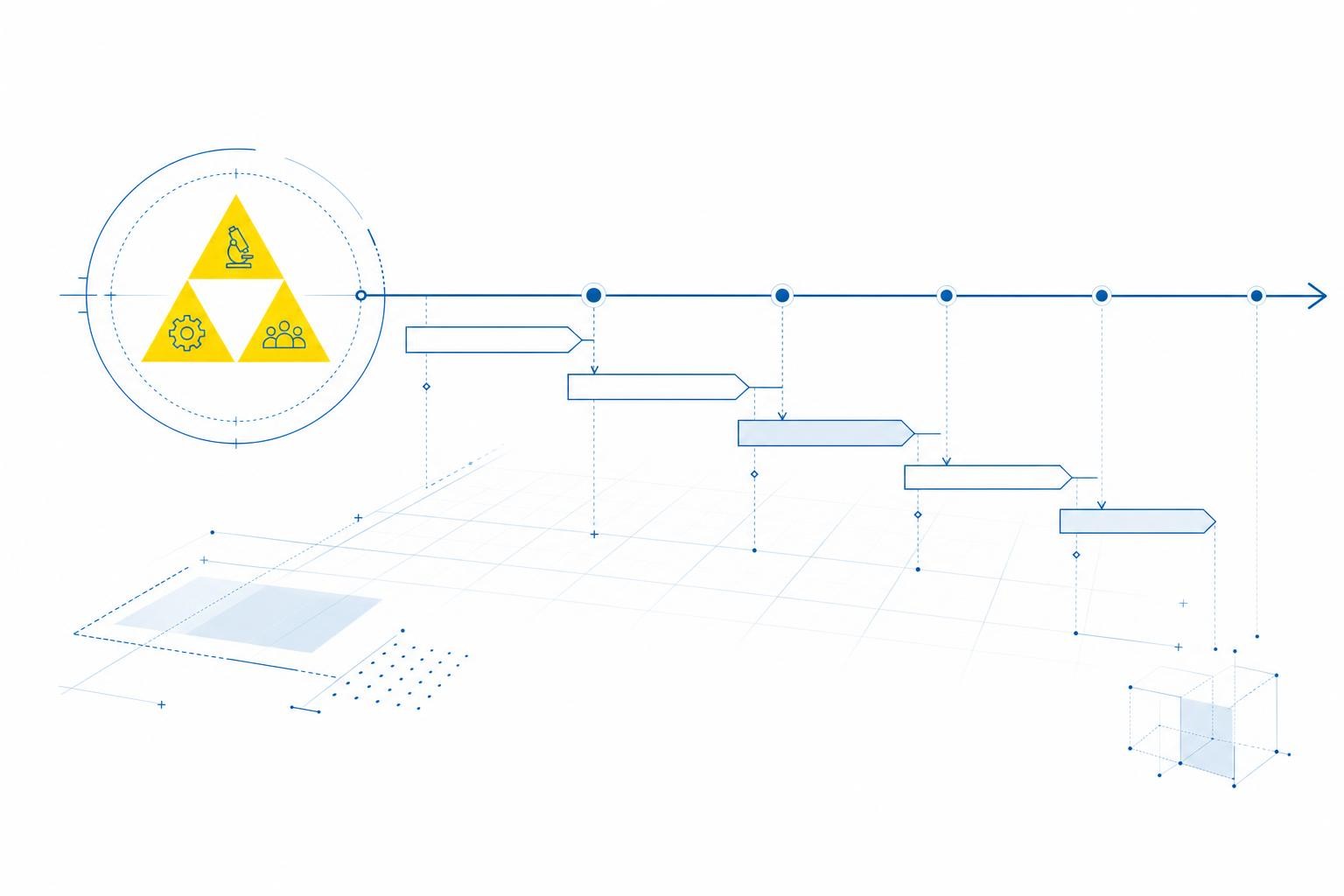
The claim that deserves the most attention is a causal one: a clearly defined scope is the basis for maintaining project timelines and limiting change orders or amendments.
That reverses how scope definition is often treated. It is frequently seen as contractual housekeeping - necessary, tedious, and separable from the technical work. Gerschewski's framing makes it the mechanism by which a timeline holds.
The reasoning is straightforward once stated. A change order is not merely an invoice; it is a renegotiation. It consumes management attention on both sides, pauses decisions while commercial terms are settled, and inserts delay at precisely the point where the technical team was ready to proceed. A vague initial scope guarantees a stream of them, because every unstated assumption eventually surfaces as a question that has to be re-agreed.
Defining scope tightly at the outset is therefore not about limiting what the CDMO will do. It is about ensuring that the work does not repeatedly stop to ask what it is.
Three variables, always in tension
Gerschewski frames the risk profile of a transfer around three things that must be understood together: time, budget, and quality.
Naming all three matters, because transfers are frequently discussed as though only one is live. A sponsor under investor pressure optimises for time. A sponsor conserving runway optimises for budget. Quality is often treated as fixed - non-negotiable, and therefore not part of the trade-off.
In practice the three move against each other. Compressing a timeline may mean running activities in parallel that would otherwise be sequential, which raises the cost of being wrong. Constraining budget may mean fewer confirmatory studies, which shifts risk onto the GMP batch. These are legitimate choices, but only when made deliberately and with a shared understanding of what is being traded.
The failure mode is an unstated priority - where the sponsor believes the timeline is paramount and the CDMO believes the budget is, and neither discovers the mismatch until a decision forces it.
Transparency as a risk control
The most pointed statement in the discussion is about information rather than technology. In Gerschewski's assessment, a lack of transparency or a lack of information could significantly increase the risk of a transfer failure.
That is a strong claim, and it is worth taking seriously rather than reading as a platitude about good communication.
Transfers depend on a receiving site building an accurate model of a process it did not develop. Everything it does - the facility fit assessment, the risk analysis, the choice of which parameters to hold constant - rests on that model. Where information is incomplete, the receiving site necessarily fills the gaps with assumptions, and assumptions are where transfers break. A quirk of the process that the originating team knew about and worked around informally is exactly the kind of knowledge that fails to travel in a document package.
Two related practices follow. Gerschewski emphasises transparency about upcoming challenges together with mitigation options - surfacing problems while they are still forecasts rather than events. And he stresses clear, timely data exchange in all directions, which is a reminder that the obligation is not one-way. A receiving site that does not report an anomaly promptly is as much a source of risk as a sponsor who omits process history.
Speed of decision, not just speed of work
The final element is decision latency. Gerschewski identifies fast decision-making as key - a point about governance rather than laboratory throughput.
Transfers generate a steady stream of choices that cannot be made unilaterally: whether an observed difference is acceptable, whether to run a confirmatory study, which of two adaptation options to adopt. Each of these sits on the critical path while it waits for an answer.
A technically excellent transfer can still miss its schedule if decisions queue for approval. The practical implication for sponsors is to establish, before the project starts, who can decide what and how quickly - because the cost of an unclear decision path is paid in weeks.
What this asks of the sponsor
Read as a whole, the argument places real obligations on the client side of the relationship, which is unusual for a discussion of CDMO capability.
Comprehensive planning and early alignment. A scope specific enough to be a constraint. An honest statement of which of time, budget, and quality actually dominates. Full disclosure of process history, including the inconvenient parts. And a decision-making structure that can keep pace with the work.
None of that is glamorous, and none of it is technical. It is, on this account, most of what separates a transfer that holds its timeline from one that does not.
Based on a BioPharm International discussion with Henning Gerschewski, VP Manufacturing Science and Technology, Rentschler Biopharma SE, and Patrick Cushing, Ph.D., VP Operations, Rentschler Biopharma Inc., hosted by Megan Manzano. Watch the full discussion.
Scoping a technology transfer? Talk to our Business Development team.