Scale-Independent Parameters: The Discipline Behind a Clean Tech Transfer
There is a comfortable fiction in technology transfer: that a process can be picked up in one facility and set down in another unchanged. It almost never survives contact with a real receiving site.
In a recent BioPharm International discussion, Henning Gerschewski, VP Manufacturing Science and Technology at Rentschler Biopharma, put the problem plainly - the most common challenge is the inherent difference between the sending and receiving sites, whether in equipment, production scale, or consumables.
Those differences, in his framing, "almost always require some degree of process adaptations." The question is therefore not whether the process will change. It is which changes are genuinely necessary, and how you demonstrate that they did not matter.
Which parameters travel, and which don't
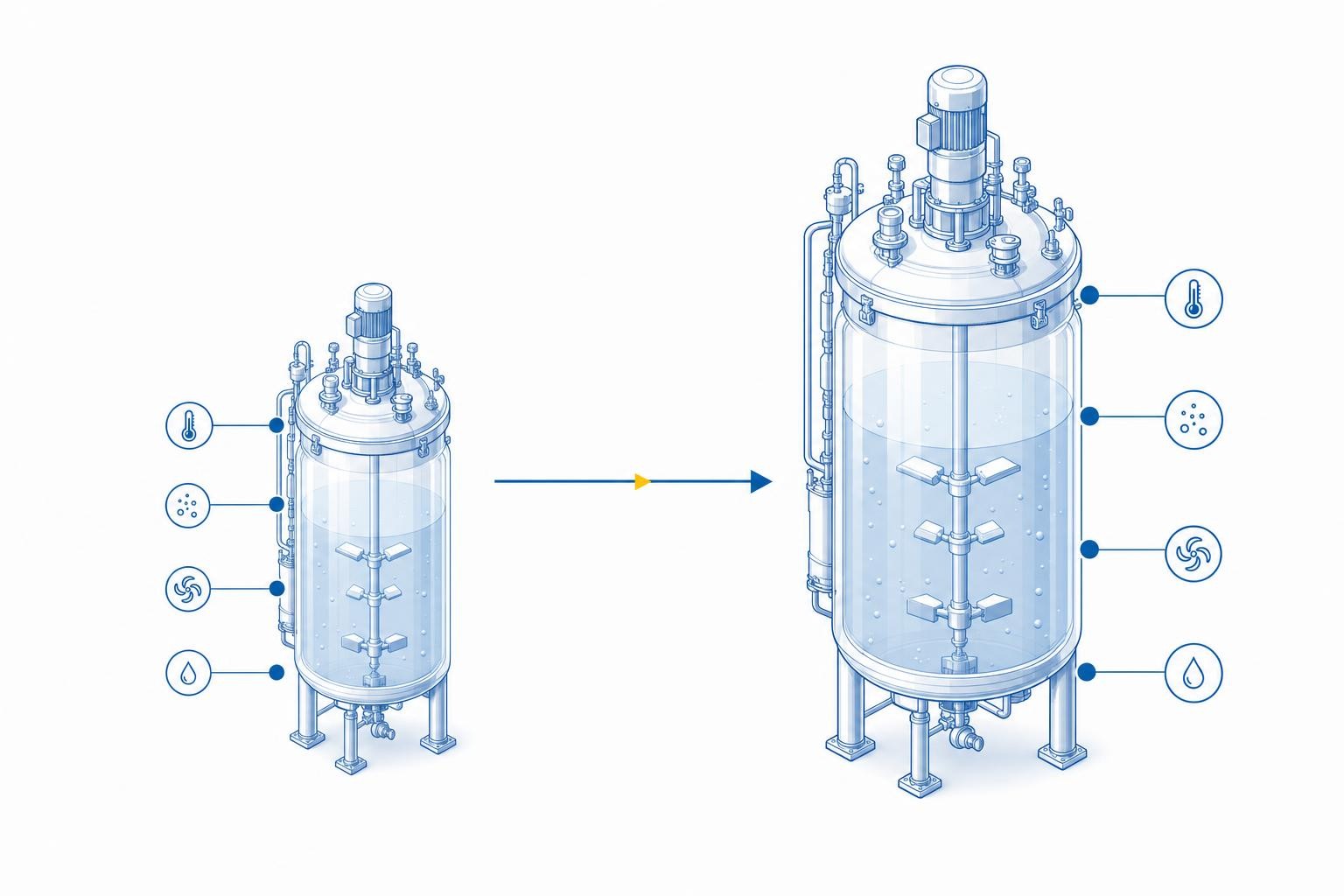
The technical core of the answer is the distinction between parameters that depend on scale and parameters that do not.
Some attributes of a process are properties of the chemistry and biology - pH, temperature, medium composition, residence time in a chromatography step, the ratios that govern a reaction. Move the process into a bigger vessel and these should hold.
Others are properties of the equipment - impeller speed, gassing rates, mixing times, filter areas, tubing dimensions. These necessarily change with scale and hardware, and trying to hold them constant across sites is usually the wrong instinct.
Gerschewski describes understanding and defining scale-independent parameters as key to a smooth, fast, and reliable transfer. The logic is that if you know which parameters carry the process's identity, you know which ones must be preserved - and you gain the freedom to let the rest adapt to the receiving facility.
Without that map, teams tend toward one of two failure modes: replicating equipment settings that were never meaningful, or changing things that quietly mattered.
Minimal necessary change
The second principle follows from the first, and Patrick Cushing, VP Operations at Rentschler's Milford site, frames it as a communication problem as much as a technical one - effective collaboration among the global project team's subject matter experts is what identifies the minimal necessary process changes.
The word doing the work is minimal. Every change introduces a burden of proof. Each one has to be justified, assessed for its impact on product quality, and supported with data. A transfer that accumulates unnecessary changes accumulates unnecessary work, and every additional variable makes it harder to interpret the eventual comparison.
There is also a regulatory dimension. The end state of a transfer is a demonstration of process equivalence - evidence that the product made at the receiving site is the same product. Cushing describes the close collaboration between sites as what determines the appropriate studies and the data needed to demonstrate that equivalence. Fewer, better-justified changes make that case cleaner to build and easier to defend.
Deciding the scope early, not discovering it late
The costliest version of process adaptation is the unplanned kind - discovered mid-transfer, when the schedule is already committed.
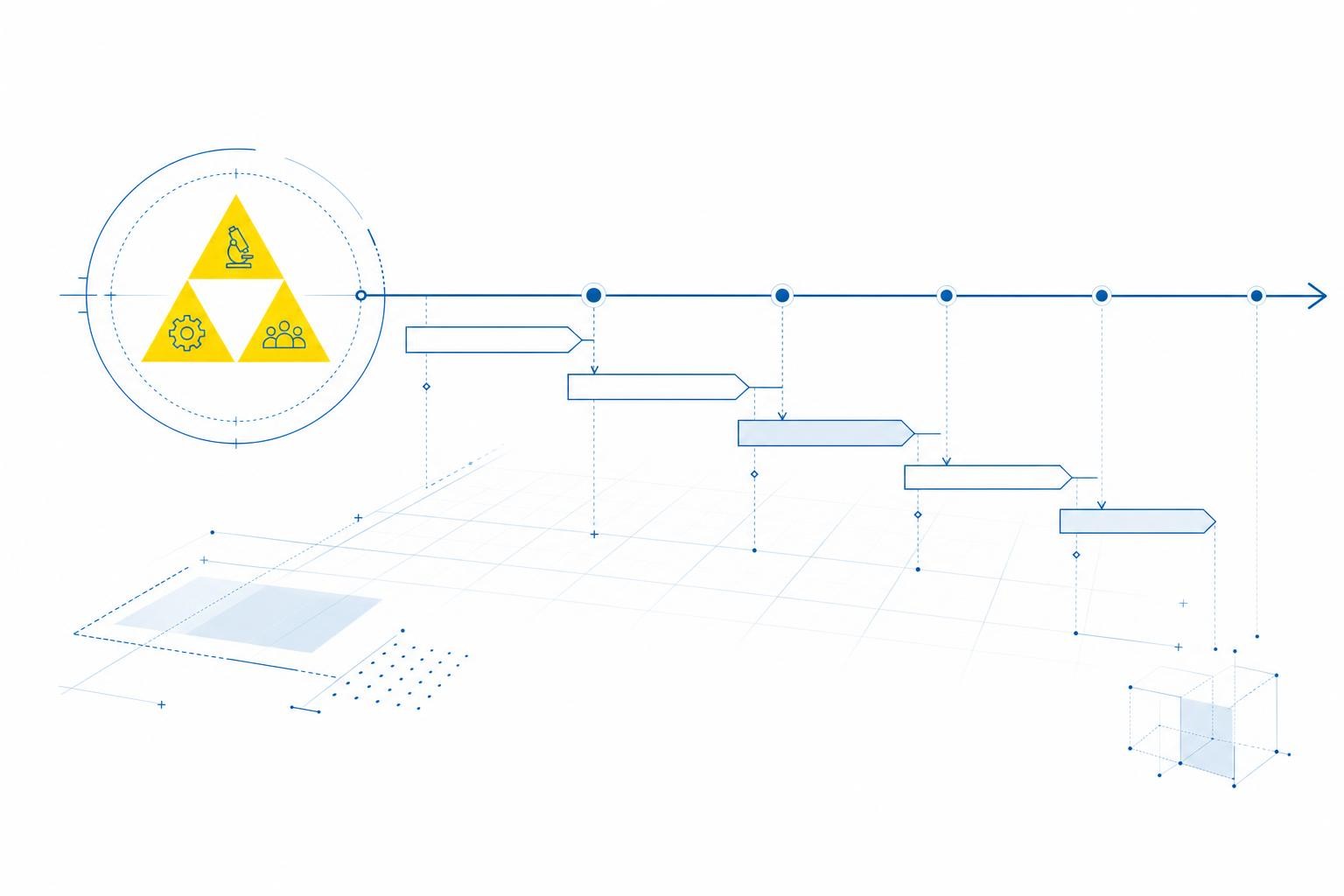
The alternative is to treat the scope of adaptations as something determined up front. Gerschewski describes determining the scope of these adaptations early, alongside the risk mitigation strategy, as critical to de-risking the transfer. That systematic approach, in his words, "helps reduce uncertainty for both sides."
That phrase deserves emphasis: both sides. A transfer is often discussed as though the receiving site carries all the risk. In practice the sending organisation is equally exposed - to timeline slippage, to comparability questions, to a GMP batch that does not perform. A shared, explicit map of what will change and why is what aligns the two parties.
Testing the options before they matter
One practice from the discussion is worth isolating, because it is where the philosophy becomes concrete.
Rentschler offers clients a formal risk assessment that identifies potential risks in the transfer and sets out the mitigation measures to be implemented. Where several viable options exist for handling a particular adaptation, those options can be tested early, during the transfer phase, rather than settled by argument.
The intent is to arrive at the GMP batch having already resolved the open questions experimentally. Deferring a choice to the first GMP run means discovering the answer at the most expensive possible moment; testing it during transfer converts a risk into a data point while it is still cheap to be wrong.
The underlying stance
What connects these practices is a refusal to treat process adaptation as an unfortunate accident. Differences between sites are a given. The engineering discipline lies in knowing which differences are permissible, keeping the rest to a minimum, and generating the evidence that the product did not notice.
As Gerschewski put it, the goal throughout is to make sure important therapies move reliably from early development into cGMP manufacturing - which is ultimately what a transfer is for.
Based on a BioPharm International discussion with Henning Gerschewski, VP Manufacturing Science and Technology, Rentschler Biopharma SE, and Patrick Cushing, Ph.D., VP Operations, Rentschler Biopharma Inc., hosted by Megan Manzano. Watch the full discussion.
Planning a technology transfer? Talk to our Business Development team.