Stable by Design: Why Predictable Clone Stability Lets You Bank Earlier

Clone instability is one of the more expensive things that can go wrong in early development, largely because of when it is usually discovered. A clone that drifts - losing productivity or gene copies over successive passages - often reveals the problem only after banking, after process development has been built around it, and sometimes after material has been made.
The standard defence is caution: hold the master cell bank until stability has been demonstrated. It works, but it parks a long-lead activity late in the schedule, right on the critical path.
The alternative is to make stability predictable enough that the caution is no longer the binding constraint.
Two kinds of stability, and why both are needed
A stability study has to answer two related but distinct questions.
Phenotypic stability asks whether the cell still performs - is final fed-batch titer maintained as the culture ages? This is what matters commercially, since a clone that loses productivity between banking and manufacturing undermines the process it was chosen for.
Genotypic stability asks why - is gene copy number preserved? A clone can lose productivity for several reasons, but copy-number loss is among the most common and most irreversible.
Measuring only titer tells you that something changed without telling you what. Measuring both gives a mechanistic read: consistent copy number alongside consistent titer is a much stronger claim than either alone.
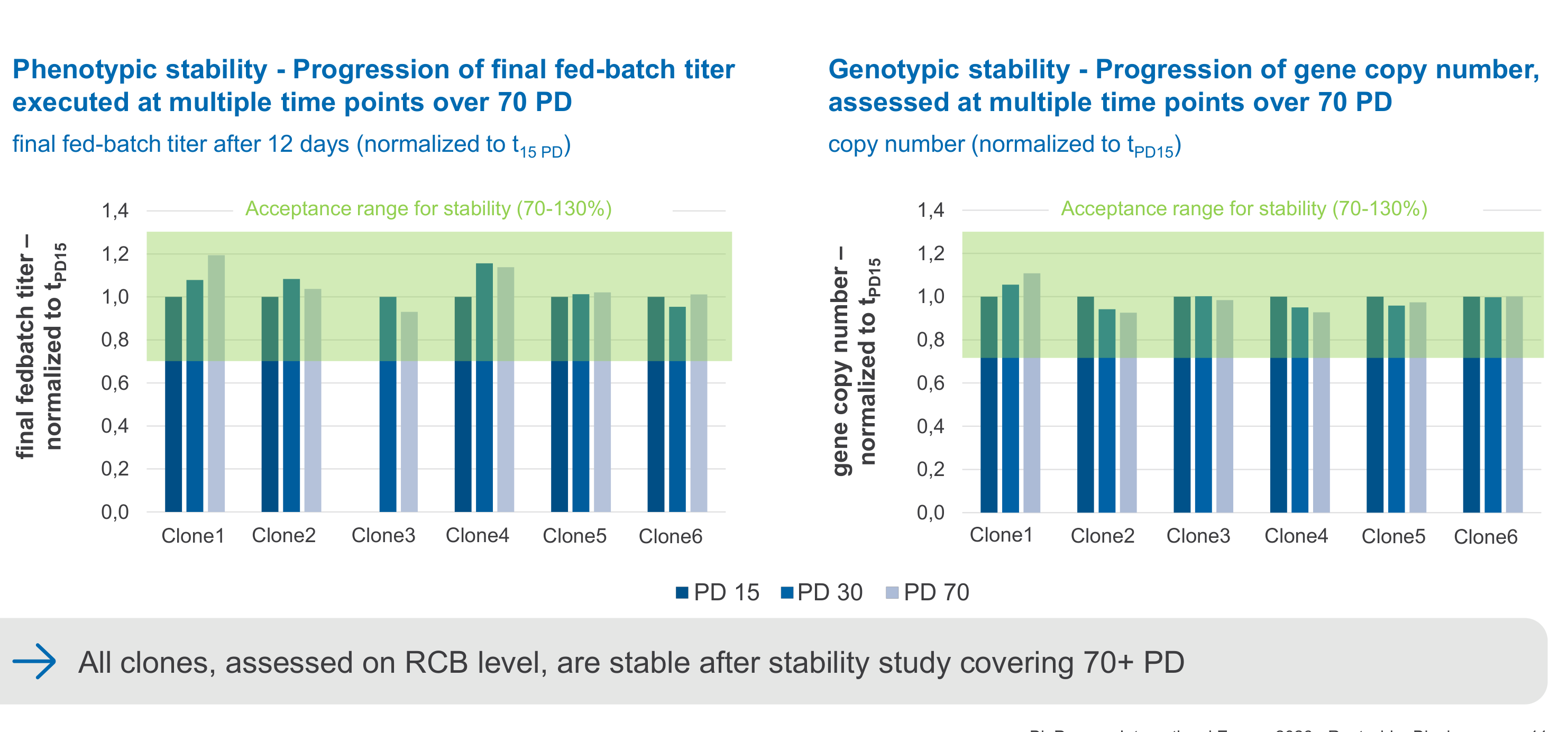
Left: final fed-batch titer. Right: gene copy number. Both normalised to the 15-population-doubling reference point and assessed at PD 15, PD 30 and PD 70 against the shaded 70-130 % acceptance range. Source: Rentschler Biopharma, BioProcess International Europe 2026.
In the work presented, clones were assessed at multiple time points across more than 70 population doublings - well beyond what a typical manufacturing campaign requires. Both measures held, and the paired reading is what carries the argument: titer does not merely hold, it holds while copy number holds, which points at retention rather than compensation.
Consistency across projects is the real claim
A single stable clone is unremarkable. Any platform produces some.
The more consequential observation is repetition.
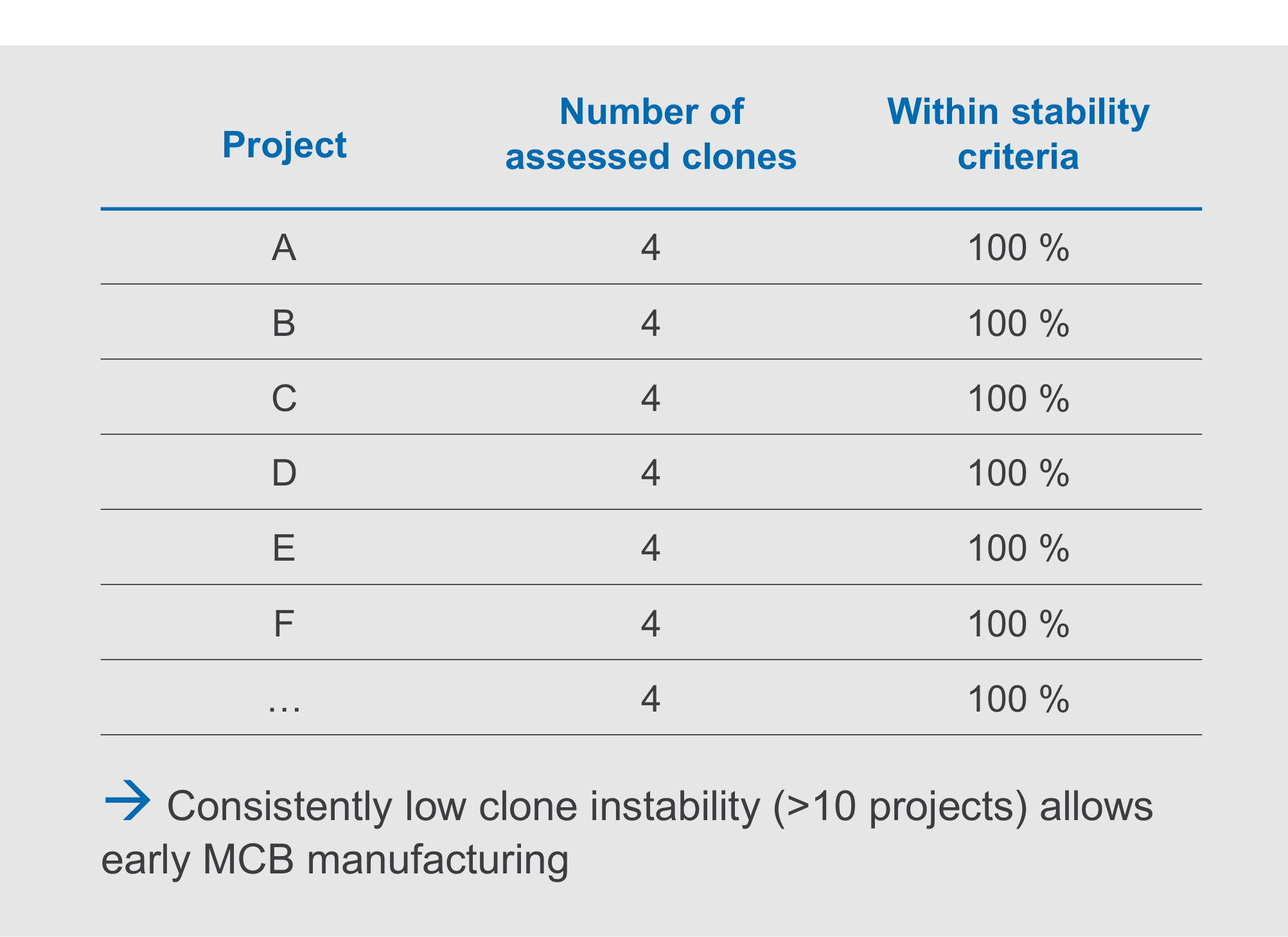
Stability outcomes by project, four clones assessed each. Source: Rentschler Biopharma, BioProcess International Europe 2026.
Across more than ten projects, with four clones assessed per project, all clones fell within the stability criteria.
That shifts stability from an outcome you hope for to a property you can plan around. If instability were sporadic, every programme would need to treat it as a live risk and schedule accordingly. If it is consistently absent across a platform, the schedule can be built on the expectation of stability - with verification still performed, but no longer gating everything behind it.
This is the evidentiary basis for preponing master cell bank manufacturing. Bringing the MCB forward is only rational if the probability of banking an unstable clone is genuinely low, and that probability is established by track record across projects rather than by any single dataset.
Stability as a consequence of integration strategy
The framing of "stable by design" is a claim about causation, and it is worth examining rather than accepting.
Where the gene lands in the genome influences both how well it is expressed and how stably it is retained. Random integration produces a wide range of outcomes on both counts - including clones that start strong and decay, because the integration site is transcriptionally active but unstable.
Semi-targeted integration narrows that variability. Directing the construct toward favourable, stable genomic locations means the clones emerging from screening are drawn from a population already biased toward retention. Stability is inherited from the integration strategy rather than discovered afterwards by screening it out.
That is a mechanistic account, and it makes the cross-project consistency easier to credit: it explains why the result repeats rather than merely reporting that it does.
What it does and does not remove
It is worth being precise about the boundaries.
Consistent platform stability does not eliminate the need for a stability study - regulators expect clone-specific data, and a track record across other molecules is not a substitute for evidence on yours. What it changes is the risk posture around scheduling: the study is performed to confirm an expectation rather than to discover an unknown.
Nor does it address the other reasons a programme might be delayed. Stability is one input to the timeline. It happens to be one that, when unpredictable, forces a conservative sequence - and when predictable, permits a parallel one.
That is the practical value: not that stability testing goes away, but that it stops dictating the order in which everything else happens.
Based on "Accelerate your Cell Line Journey: How high-performance Cell Line Development shortens time from DNA to IND" presented by Britta Reichenbächer, Senior Process Manager CLD & GC, at BioProcess International Europe 2026 in Vienna.
Questions about clone stability for your programme? Talk to our Business Development team.