Where the Model Agrees, and Where It Doesn't: Validating Virus Removal Predictions

A model that fits its own calibration data proves very little. The interesting question is what happens when you point it at a dataset it has never seen.
For the structure-based model of minute virus of mice (MVM) removal described in earlier articles in this series, that test was run against a previously collected set of MVM spiking studies - real infectious virus, on the same multimodal anion exchange resin and buffer system, but with different molecules.
The answer was neither a clean pass nor a failure. It was more useful than either.
Right where it matters most
The region that governs process design is the edge of failure - the narrow window where removal transitions from robust to inadequate. That is what defines an operating range, and it is what a regulator will ask about.
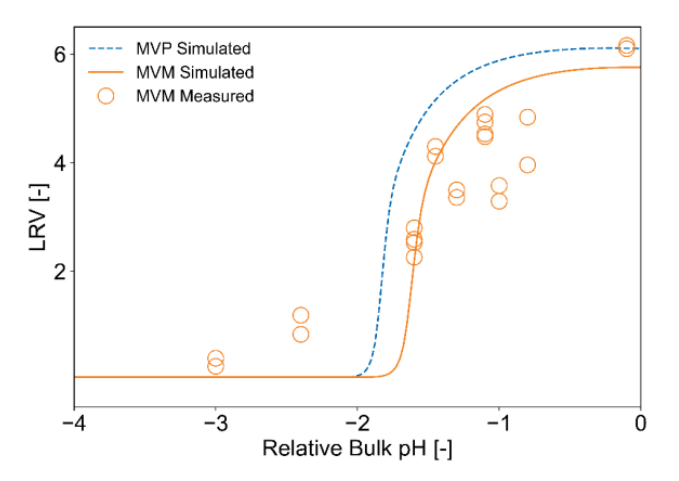
Predicted and measured log reduction values for MVM against an independent spiking dataset. The MVP simulation is shown for comparison.
Across that transition, the prediction and the measurements agreed closely. The model - whose charge parameter came from an AlphaFold2-augmented structure, and whose remaining parameters were transferred wholesale from the mock virus particle model - placed the cliff in the right position.
It also reproduced the shift between MVM and its surrogate. The MVM curve is displaced relative to MVP, consistent with the externalised PLA2 domain adding charged residues to the capsid surface below pH 6.
The divergence, and what it says
At higher clearance - effective log reduction values above about 4 - the picture changed. The experimental data scattered considerably, and several measurements came in lower than the model predicted.
It would be easy to present this as a limitation and move on. The more interesting reading is what the deviation is made of.
The proposed explanation is product-specific: interactions between the MVM capsid and particular monoclonal antibodies. Virus-antibody interactions reducing viral clearance in anion exchange chromatography have been reported before, and they would produce exactly this signature - clearance that underperforms a purely electrostatic prediction, varying by product rather than by process condition.
That distinction has practical weight. It suggests the model captures the physics of the separation, while the residual variability comes from chemistry it does not attempt to describe. For a process scientist, that is a far more actionable diagnosis than "the model is approximately right." It says: trust the predicted edge of failure; treat high-LRV claims with product-specific verification.
There is also a mundane contributor worth keeping in view - the validation dataset was assembled from studies run with different molecules and varying impurity levels, which will widen scatter on its own.
A parameter that may travel between resins
The second finding is the one with the longest reach.
In the colloidal particle adsorption framework used here, the virus-specific parameters are defined independently of the adsorber. In principle, then, a charge curve derived for a virus should not be tied to the resin it was calibrated on.
That principle got a check. The structure-derived charge polynomial for the mock virus particle was compared against a charge polynomial determined experimentally on a completely different resin - Q Sepharose FF - and published separately.
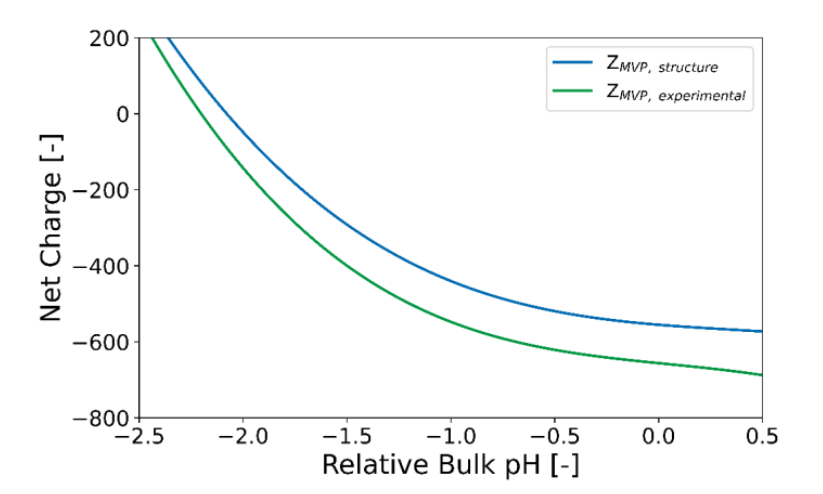
Charge polynomial derived from capsid structure compared with an experimentally determined polynomial for Q Sepharose FF.
The two closely resemble each other in shape. They are not identical - there is a discrepancy near the apex, which the authors suggest could be resolved by adjusting the boundary layer thickness rather than the charge itself.
If that transferability holds up under wider testing, the consequence is significant: in silico comparison of resins for virus clearance. Screening chromatography media for viral safety experimentally is prohibitive, because each candidate multiplies the number of spiking studies. Being able to carry a virus's charge description from one adsorber to another turns part of that screen into simulation.
The authors are appropriately measured about this - it is described as feasible and warranting further validation, not established.
Where this is heading
The stated ambition goes beyond two parvoviruses. Combining the structure-based charge derivation with quantitative structure-property relationships and machine learning could, in principle, extend removal predictions to a broad panel of viruses.
That would change what a virus clearance package can be built from: assessing whether a process removes a spectrum of viruses via validated models, rather than extrapolating from a small set of costly spiking studies. The knowledge that currently takes years of accumulated experimental work could be generated in a substantially shorter time.
That destination is some way off, and the honest framing of the present work is that it demonstrates feasibility on a narrow, well-controlled case. But the direction is clear, and the economics behind it - spiking studies are expensive, and that cost limits process understanding - are not going to change.
Based on "Structure based Mechanistic Chromatography Modeling of Mock Virus Particle and Minute Virus of Mice removal using Multi Modal Anion Exchange Chromatography" by Lukas Döring, Thomas Holder, Johannes Winderl, Jonas Kowert and Matthias W. Kron (Process Science, Rentschler Biopharma SE) with Jürgen Hubbuch (Institute of Engineering in Life Sciences, KIT).
Designing a virus clearance strategy for your process? Talk to our Business Development team.