Less Screening, Same Performance - But Titer Is Not the Only Thing to Screen For
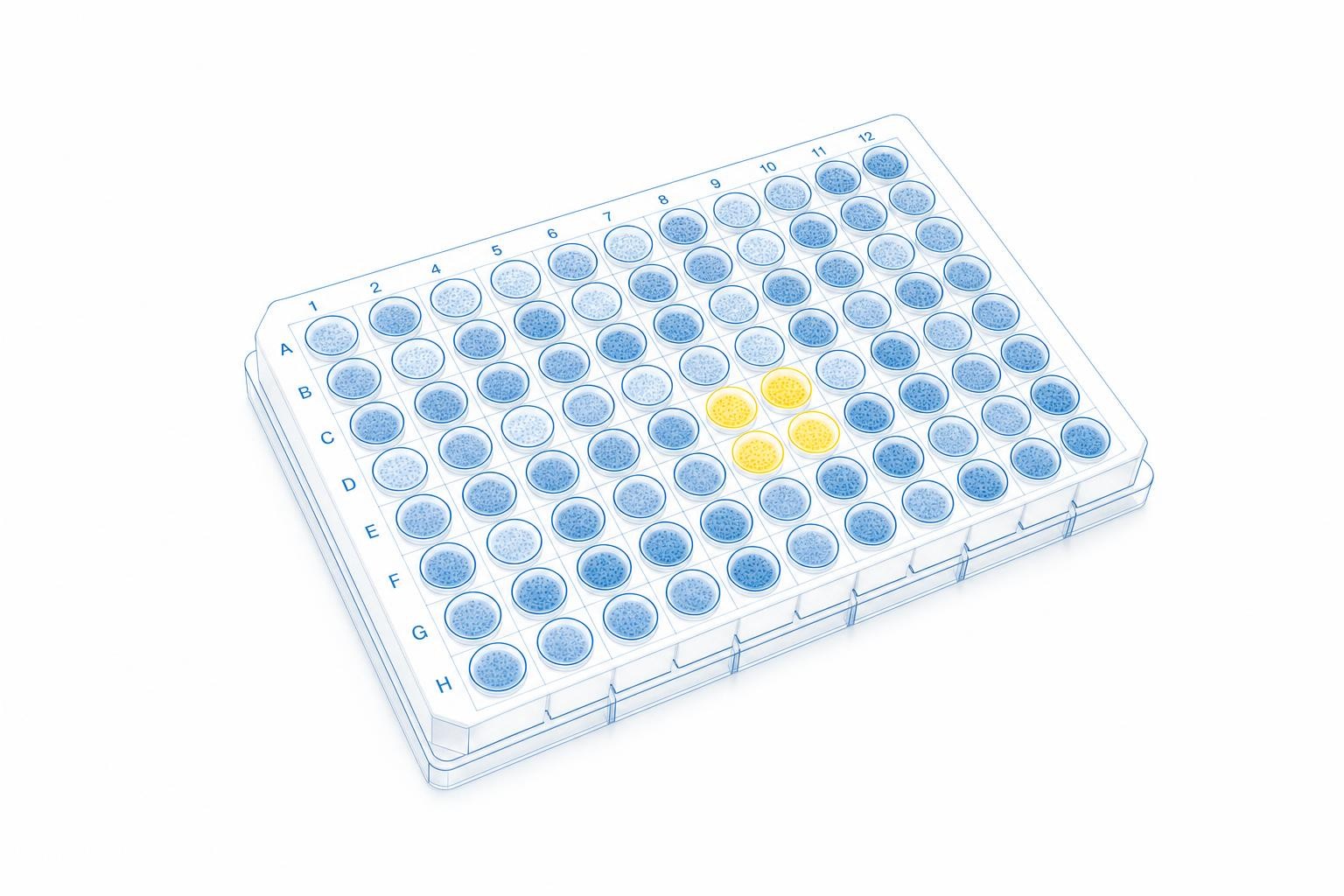
Clone screening has historically been a numbers exercise. Because random integration scatters the gene of interest across the genome, the resulting population is wildly heterogeneous - and finding the rare high performer means looking at a great many candidates.
That logic holds only as long as the heterogeneity does. Change how the gene gets in, and the arithmetic changes with it.
Where the screening burden actually comes from
Random integration produces clones that differ enormously in productivity, because expression depends heavily on where in the genome the construct landed. Screening thousands is a rational response to that variance: the distribution has a long tail, and the winners live in it.
Semi-targeted integration compresses that distribution. When the construct is directed to favourable genomic locations rather than scattered, the pool is far more uniform - and a more uniform pool means the top performers are not statistical rarities requiring an enormous search.
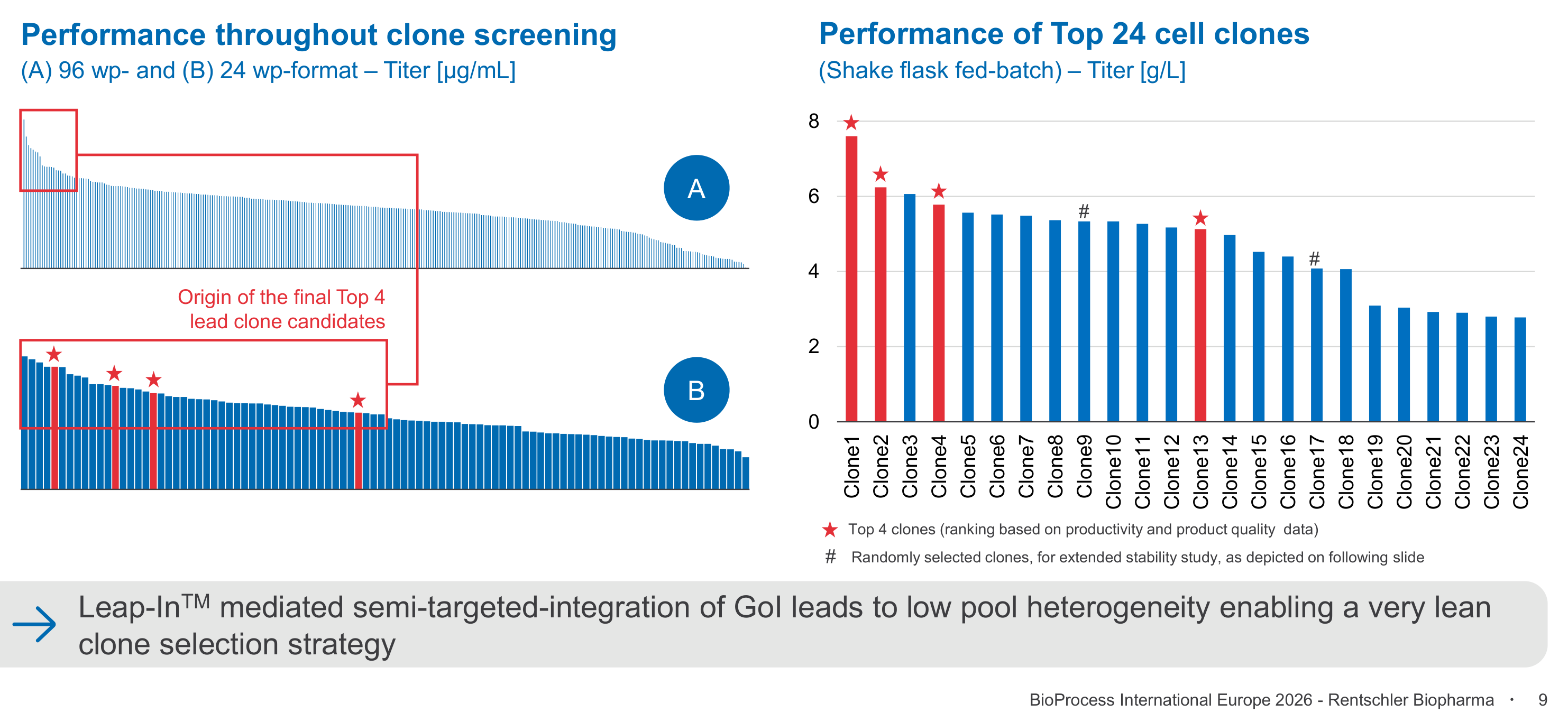
Left: performance across 96-well (A) and 24-well (B) screening formats, with the region that produced the final top four lead clone candidates highlighted. Right: fed-batch titers of the top 24 clones in shake flask. Source: Rentschler Biopharma, BioProcess International Europe 2026.
The observable consequence is worth stating carefully: the clones that ultimately became the lead candidates originated from the upper portion of the distribution that a much smaller screen would already have captured. The best clones were not hiding in a tail that only exhaustive screening could reach.
That is what makes a lean selection strategy defensible rather than merely cheaper. You are not accepting a worse clone in exchange for less work; you are recognising that the extra work was searching a distribution that no longer has the same shape.
The finding that complicates the story
Here is where it would be easy to overclaim, and where the data pushes back.
Low heterogeneity in productivity does not mean uniformity in product quality. Clones derived from the same low-heterogeneity pool still show meaningful variation in quality attributes - glycosylation profiles and monomer content among them - relative to the parental pool.
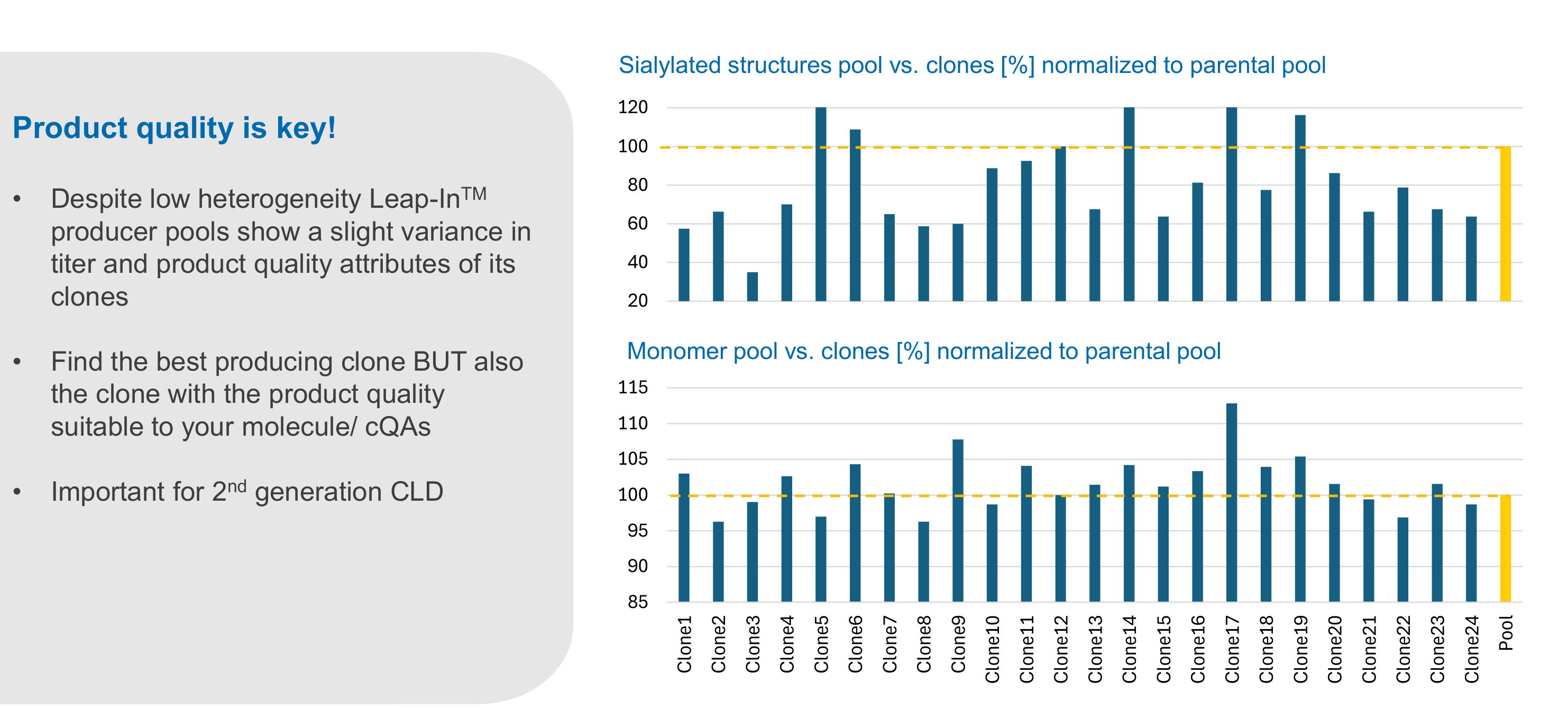
Sialylated structures (top) and monomer content (bottom) for individual clones, each normalised to the parental pool shown at right. Source: Rentschler Biopharma, BioProcess International Europe 2026.
The sialylation panel makes the point most sharply. Against a parental pool set at 100 %, individual clones range from roughly 35 % to 120 % - a spread far wider than the productivity data would lead you to expect. Monomer content varies too, though across a narrower band.
Some clones sit above the parental pool on a given attribute, some well below. The spread is not noise; it is real clone-to-clone difference in how the molecule is made, not just how much of it is made.
This has a direct operational implication: screening on titer alone will find you a productive clone and tell you nothing about whether it makes the right product. A clone that leads on productivity may sit at the wrong end of a glycosylation distribution that matters for your molecule's efficacy or comparability position.
So the lean screen is lean in breadth, not in dimensions. Fewer clones, but each assessed on productivity and on the quality attributes that matter for that specific molecule.
Why "for that molecule" is doing work in that sentence
There is no universal ranking of clones. Which quality attributes matter depends entirely on the product - its mechanism, its route, its regulatory context, and for a biosimilar or second-generation product, the profile it needs to match.
That last case is worth calling out. In second-generation cell line development, where the target is often a defined quality profile rather than maximum output, the ability to select a clone by quality attributes is not a refinement - it is the entire objective. Choosing the highest producer would actively work against the goal.
The practical framing for a development team: define the critical quality attributes before the screen, not after it. A screen designed around titer cannot be retrospectively repurposed to answer a quality question.
What this changes in practice
Two things follow.
First, the resource case. A leaner screen frees capacity and shortens the clone selection stage, which sits on the critical path to material supply and master cell banking.
Second, and less obvious - a smaller, well-chosen candidate set makes deeper characterisation affordable. Assessing twenty-four clones across productivity and multiple quality attributes is tractable in a way that assessing several thousand on the same panel is not. The screen gets narrower and simultaneously more informative.
The end state is a lead clone chosen on evidence across both axes, reached without an exhaustive search - provided the quality axis was built into the screen from the start.
Based on "Accelerate your Cell Line Journey: How high-performance Cell Line Development shortens time from DNA to IND" presented by Britta Reichenbächer, Senior Process Manager CLD & GC, at BioProcess International Europe 2026 in Vienna.
Defining a clone selection strategy for your molecule? Talk to our Business Development team.