Five Months Off the Path to Drug Substance: What Early Cell Line Decisions Buy You
Every biologics timeline has a critical path, and cell line development sits at the head of it. Nothing downstream - process development, analytics, formulation, toxicology material, GMP manufacturing - can start in earnest until there is a cell line producing the molecule.
That sequencing is usually treated as a fact of nature. It is closer to a design choice.
The bottleneck is availability, not speed
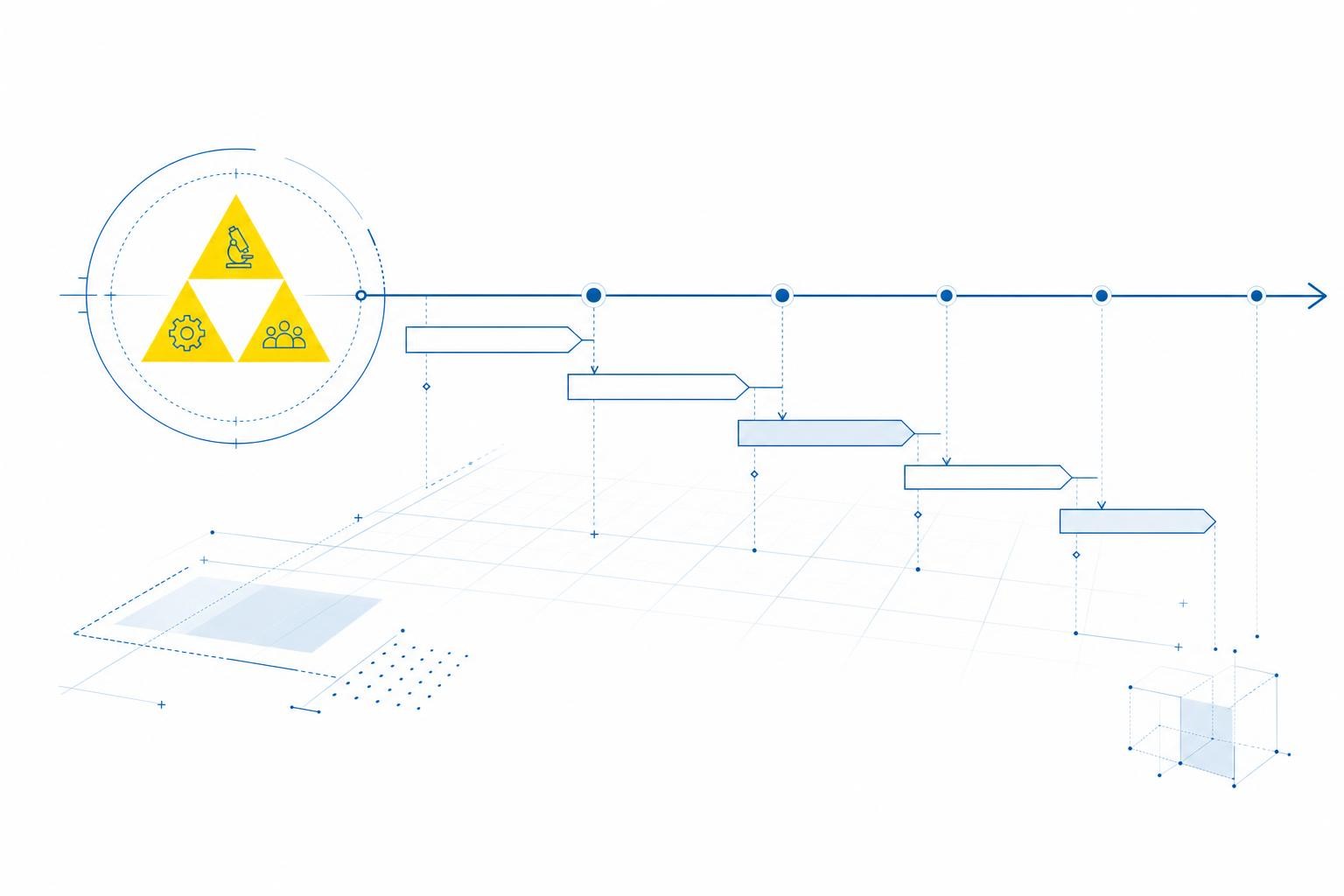
The conventional route runs in series. Generate a pool, screen clones, nominate a lead, bank it, and only then hand material to the teams waiting downstream. Each stage is reasonably efficient on its own; the cost is in the waiting.
The alternative is to decouple material availability from clone finalisation. If a stable producer pool can be in hand within about two weeks, then material supply begins almost immediately - while single-cell cloning, clone screening, and stability assessment proceed in parallel rather than afterwards.
The teams downstream do not need the final clone to begin. They need representative material. Analytical method development, downstream process development, and formulation work can all start on pool-derived material, provided that material genuinely predicts what the clone will later produce.
That proviso is the whole game. Parallelisation only works if pool material is a reliable stand-in - otherwise the downstream work gets invalidated when the clone arrives, and the apparent time saving reverses.
Why comparability between pool and clone matters so much
The risk in starting early is that you optimise a downstream process against material that turns out not to represent the final cell line - a different glycosylation profile, a different impurity spectrum, different aggregation behaviour.
This is where the integration technology does real work. Semi-targeted integration of the gene of interest produces pools with low heterogeneity, meaning the cells within a pool behave more alike than in a randomly integrated population. Low heterogeneity is what makes pool material predictive of clone material - and predictive pool material is what makes early de-risking legitimate rather than wishful.
The practical consequence is that decisions normally deferred until after clone selection can be taken earlier and with more confidence.
Preponing the master cell bank
The second lever is timing the master cell bank.
MCB manufacturing is typically held back until clone stability has been demonstrated, because banking an unstable clone is an expensive mistake. That caution is well founded - but it also parks a long-lead activity late in the schedule, where it sits directly on the critical path.
Where clone stability is consistently high across a platform, the calculus shifts. If stability outcomes are predictable rather than uncertain, MCB manufacturing can be brought forward and overlapped with other activities instead of gating them.
What it adds up to
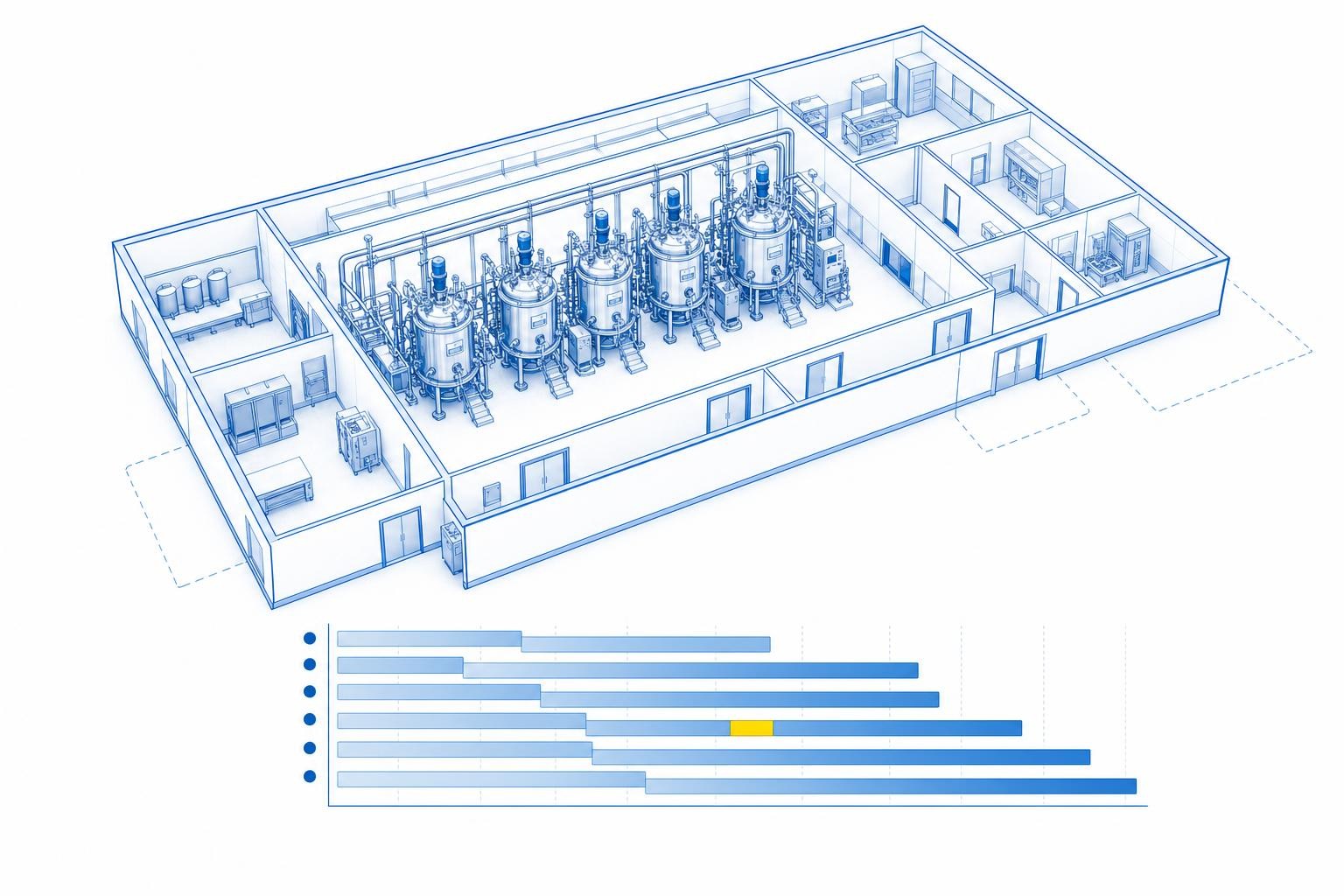
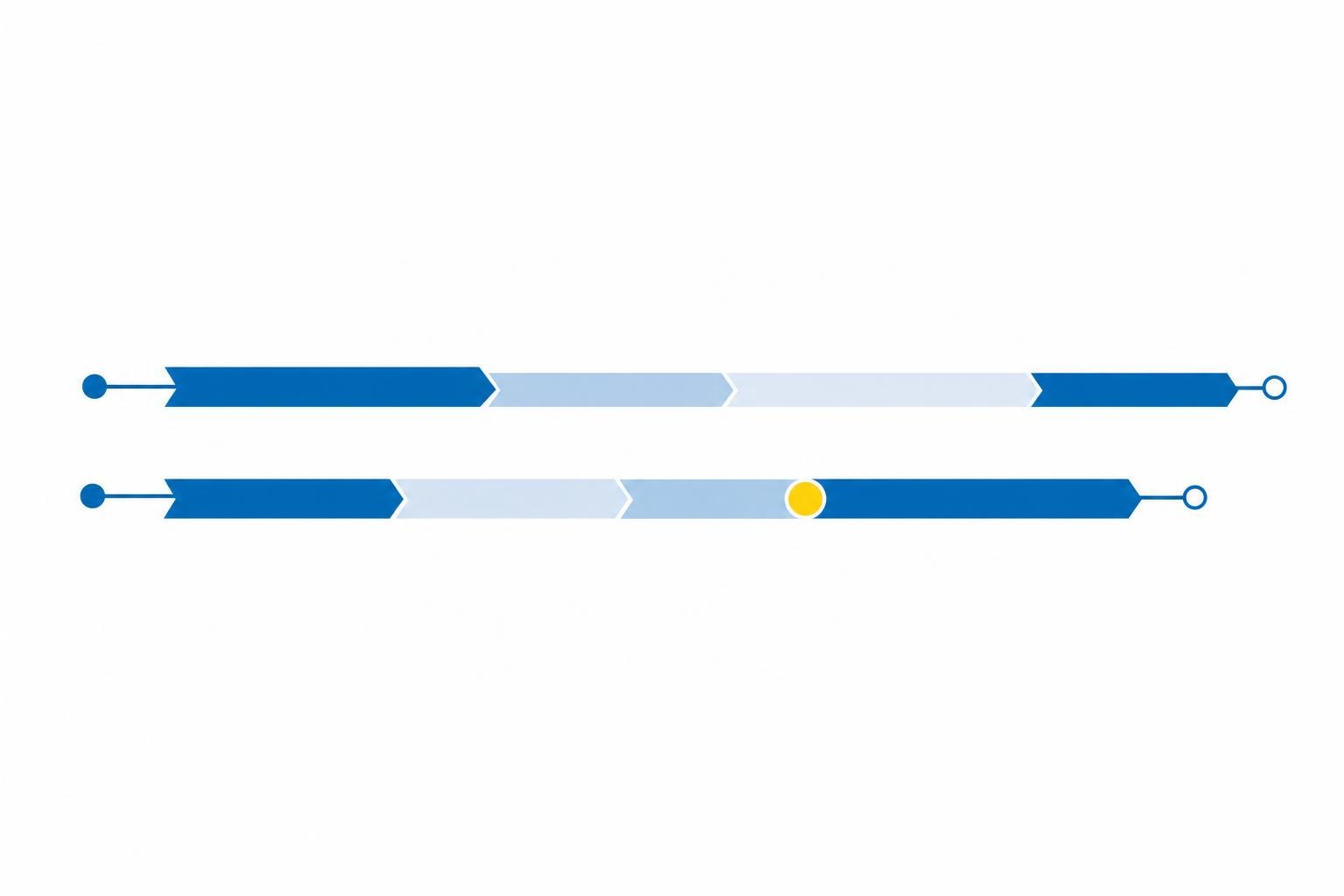
Mapped across a full development programme, these changes - pools available within two weeks, parallelised development activities, and earlier master cell banking - move the drug substance milestone forward by approximately five months.
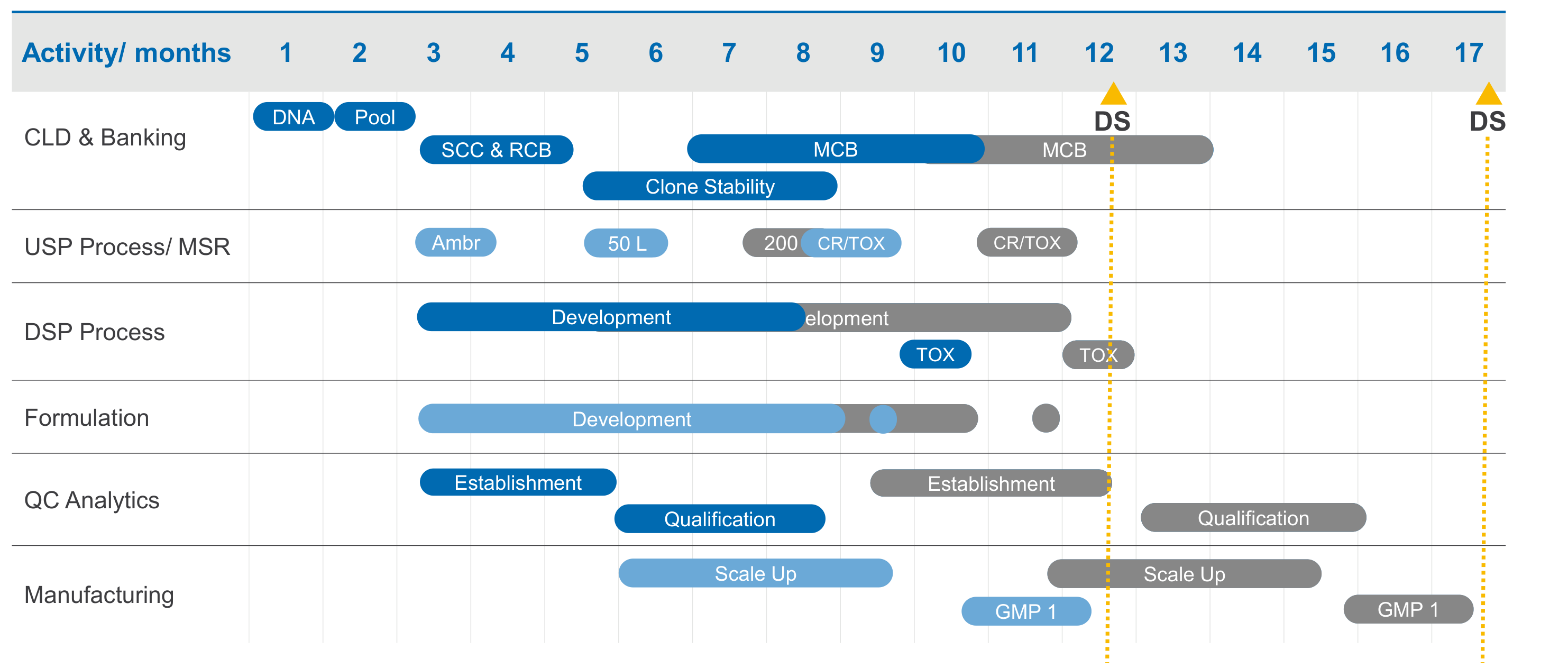
Activities across CLD & banking, USP, DSP, formulation, QC analytics and manufacturing. The two marked DS milestones show the accelerated and conventional paths. Source: Rentschler Biopharma, BioProcess International Europe 2026.
Reading across the rows makes the mechanism visible. Clone stability assessment overlaps master cell bank manufacturing rather than preceding it; DSP and formulation development begin while upstream scale-up is still running; QC method establishment and qualification are staged so they do not gate release.
Five months on a development timeline is not a scheduling detail. It is a shift in a clinical entry date, an earlier readout, and in many cases a materially different position in a competitive field.
It is worth being precise about where the saving comes from. This is not a claim that any individual step is executed faster. The gain comes from restructuring the dependency graph: converting a sequence into an overlap, which is possible only when the early material is trustworthy enough to build on.
The trade-off to weigh
Parallelisation front-loads risk. Starting downstream development on pool material means committing resources before the final clone exists, and if comparability fails, some of that work is wasted.
The judgement, then, is not whether parallelisation is faster - it plainly is - but whether the platform's pool-to-clone comparability is strong enough to justify the exposure. That question is answered by data on clone stability and product quality consistency, which is the subject of the other articles in this series.
Based on "Accelerate your Cell Line Journey: How high-performance Cell Line Development shortens time from DNA to IND" presented by Britta Reichenbächer, Senior Process Manager CLD & GC, at BioProcess International Europe 2026 in Vienna.
Planning a cell line development strategy? Talk to our Business Development team.