PPQ Explained: Where Process Performance Qualification Fits in the FDA's Validation Lifecycle

PPQ Explained: Where Process Performance Qualification Fits in the FDA's Validation Lifecycle
Process Performance Qualification is one of the most consequential milestones in a biologic's life. It is the point at which a manufacturing process stops being a promising set of conditions and becomes a validated, commercially viable process - the evidence a regulator relies on when deciding whether a product can be supplied to patients.
It is also widely misunderstood as a discrete event: a set of consecutive batches run to a protocol, after which a box is ticked. That framing is where a great many programs get into difficulty, because it obscures the fact that PPQ success is largely determined by work done long before the first PPQ batch is scheduled.
The three-stage lifecycle
Modern regulatory expectation frames validation not as an event but as a lifecycle with three stages.
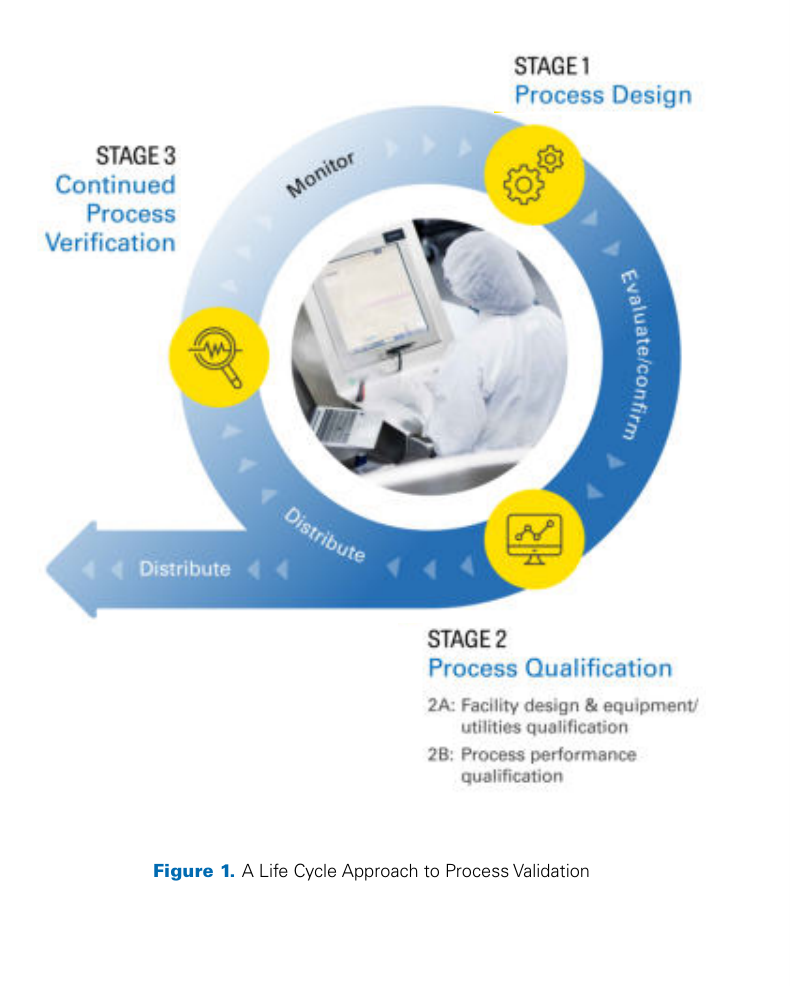
Stage 1 - Process Design
The process is defined based on knowledge gained through development and scale-up. This is where critical quality attributes are identified, where the relationships between process parameters and product quality are established, and where the control strategy takes shape.
Everything PPQ later attempts to confirm is decided here. A process design that has not genuinely explored parameter interactions leaves PPQ to discover them - at commercial scale, with commercial-scale consequences.
Stage 2 - Process Qualification
This stage divides into two distinct activities that are often conflated:
- 2A: Facility design and equipment/utilities qualification - demonstrating that the plant and its systems are capable of operating as intended.
- 2B: Process Performance Qualification - demonstrating that the process, executed in that qualified facility by trained personnel, consistently produces product meeting its quality attributes.
PPQ is therefore a subset of Stage 2, not the whole of validation. Running PPQ in a facility whose qualification is incomplete is a common and expensive sequencing error.
Stage 3 - Continued Process Verification
Validation does not end at approval. Ongoing monitoring confirms the process remains in a state of control throughout commercial production, and feeds evidence back into process understanding. Trends detected here can trigger refinement - the lifecycle is a loop, not a line.
Why PPQ readiness is decided in Stage 1
The practical implication of the lifecycle model is that PPQ is a demonstration, not an investigation. By the time PPQ batches run, there should be no open scientific questions about whether the process works - only confirmation that it performs as characterized.
Programs that treat PPQ as the moment to find out are the programs that fail. A process step with unresolved robustness issues does not become robust because it is being run under a validation protocol; it produces an out-of-specification result at the least convenient possible moment, and the resulting investigation can add many months to a timeline.
This is why identifying and remediating weak process steps before PPQ - even when that means an unwelcome detour into redevelopment - is almost always faster than pressing ahead.
What a well-prepared PPQ looks like
Three characteristics distinguish programs that pass cleanly:
A control strategy derived from data, not caution. Parameters are classified as critical because evidence shows they matter, with ranges justified by characterization studies rather than set conservatively to be safe.
Analytical methods that are ready. PPQ generates a large volume of testing under time pressure. Methods must be validated and capacity secured before the campaign, not qualified alongside it.
Scale-down models that actually predict. Much characterization evidence comes from small-scale models. If those models have not been shown to represent the commercial process, the evidence supporting the control strategy is weaker than it appears.
The regulatory conversation
A well-constructed PPQ package tells a coherent story: here is what we understand about our process, here is the evidence, here is how we control it, and here is our demonstration that the control works at scale.
Reviewers respond to that coherence. The strongest submissions are not those with the most data, but those where each piece of data has a clear role in an argument - which is only possible when Stage 1 was done thoroughly enough to know which questions mattered.
Rentschler Biopharma supports clients across the full validation lifecycle, from process design through PPQ and continued process verification. To discuss your validation strategy, contact our Business Development team.