Managing the Unexpected: Rebuilding a Chromatography Step for a PPQ-Ready Process

Managing the Unexpected: Rebuilding a Chromatography Step for a PPQ-Ready Process
Every accelerated program eventually meets an inconvenient fact. In this case it was a chromatography step that performed acceptably at development scale and then refused to behave when the process moved toward commercial scale - inconsistent elution profiles, run-to-run variability, and a separation that could not be relied upon to deliver the same product quality twice.
The step was, in the language of validation, not ready for PPQ. And the program was on an accelerated timeline with a competitor in the same indication.
This is the moment that separates programs that recover from programs that stall.
The tempting mistake
The instinctive response under schedule pressure is to tighten. Narrow the operating ranges, add controls, define the acceptable window so restrictively that variability has nowhere to go, and proceed to validation.
It is an understandable impulse and usually the wrong one. Narrow ranges do not make a process robust - they make it fragile in a documented way. A step held together by tight constraints will produce deviations in routine commercial manufacturing, and each deviation carries an investigation, a potential batch loss, and a regulatory conversation. The time apparently saved before PPQ is repaid many times over afterwards.
The alternative is to accept a short, structured detour: understand why the step fails, rebuild it, and re-enter the timeline with a process that will hold.
A structured redevelopment
Rather than adjusting parameters opportunistically, the team addressed the step in three deliberate phases, each targeting a distinct failure mode.
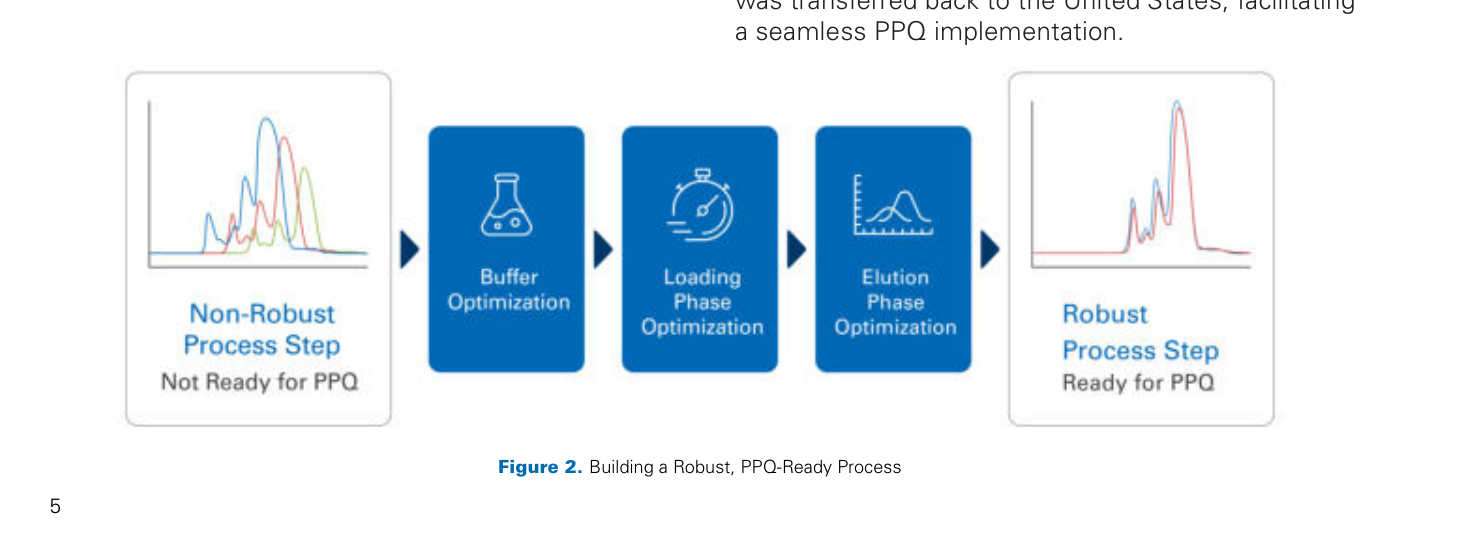
Buffer optimization
Buffer composition, pH and conductivity determine the chemical environment in which separation occurs. Small deviations here propagate into large differences in binding and elution behaviour - and buffer preparation at manufacturing scale carries more variability than the carefully prepared solutions of a development laboratory.
Optimizing composition for tolerance rather than for peak performance under ideal conditions is the first step toward a step that survives the plant.
Loading phase optimization
Load density, flow rate and residence time govern how product interacts with the resin. Load conditions optimized for maximum capacity frequently sit close to a cliff edge: a modest increase in load or a slight change in feed composition pushes the step into overload and the separation degrades sharply.
Establishing where that boundary lies - and deliberately operating at a defensible distance from it - trades a little capacity for a great deal of reliability.
Elution phase optimization
Elution conditions and gradient design determine resolution between product and impurities. The original gradient produced a separation that was adequate on a good day and marginal otherwise. Redesigning gradient shape and modifying elution conditions produced a profile with genuine margin between the product peak and neighbouring species.
The result
The chromatograms tell the story. Before redevelopment, overlaid runs diverge visibly - different peak shapes, different retention, different resolution from run to run. Afterwards, overlaid runs are nearly superimposable: the same separation, reproducibly, across conditions.
That reproducibility is precisely what PPQ is designed to demonstrate. A process that looks like the right-hand chromatogram enters validation expecting to confirm what is already known; a process that looks like the left-hand one enters hoping to get lucky.
Why this accelerated rather than delayed the program
Counter-intuitively, the redevelopment detour was compatible with an aggressive timeline - the program still completed GMP-to-PPQ in twelve months. Three factors made that possible:
The problem was found early. Robustness weaknesses discovered during development cost weeks. The same weakness discovered during PPQ costs months, because it arrives with failed batches and an investigation attached.
Redevelopment was scoped, not open-ended. Three defined optimization phases with clear success criteria - not an exploratory campaign.
Expertise was applied directly. Process characterization specialists worked on the step and then supported its execution on site, so the knowledge generated during redevelopment travelled with the process rather than staying in a report.
The general lesson
Accelerated timelines do not tolerate weak process steps; they expose them faster. The instinct to defer a known robustness problem in order to protect a schedule is almost always a false economy.
Fixing the step is not a deviation from the fast path. Very often, it is the fast path.
Rentschler Biopharma's process characterization teams support clients in building robust, PPQ-ready processes. To discuss a challenging process step, contact our Business Development team.