A 42% Titer Uplift With Design of Experiments - Without Trading Away Quality
A 42% Titer Uplift With Design of Experiments - Without Trading Away Quality
Titer improvements are easy to promise and surprisingly hard to bank. Most processes can be pushed to produce more protein; the difficulty is producing more protein that is just as good. A 40% yield gain accompanied by a shifted glycosylation profile or an aggregation increase is not a gain at all - it is a comparability problem wearing a flattering number.
So the interesting question about the case below is not the size of the improvement. It is what did not change.
Starting point: a process that worked
The program in question already had a functioning commercial-scale process. Material was being produced at 1000 L, with a 10 L satellite run alongside the at-scale campaign to allow small-scale investigation without consuming production capacity.
That satellite arrangement is worth noting, because it is what made the subsequent optimization credible. A small-scale model that has been run in parallel with the full-scale process - and shown to track it - is a very different instrument from a small-scale model assumed to be representative.
Where the gains came from
Late-stage optimization used designed experiments rather than sequential adjustment. Media composition, feed strategy and process conditions were varied together in a structured design so that interactions between them became visible.
That matters because the largest gains in mammalian cell culture usually sit in interactions rather than in individual factors. A richer feed helps only if the culture conditions allow the cells to use it; a temperature shift helps only if it is timed against the metabolic state the feed produces. One-factor-at-a-time work finds the individual effects and misses the combinations.
The result: 104 -> 140 and 143
Normalized against the at-scale 1000 L production run, the picture is straightforward.
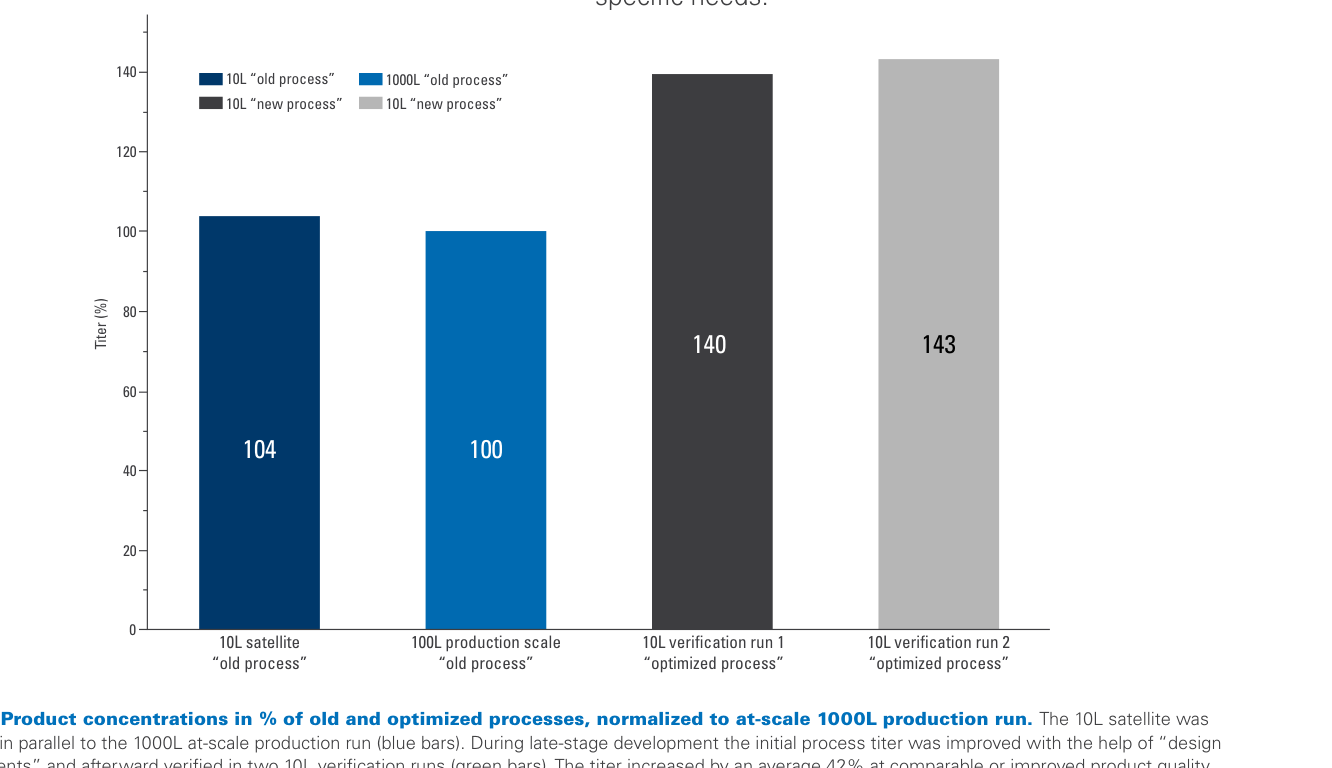
The original process delivered 104% at 10 L satellite scale and 100% at production scale - the small-scale model tracking the large-scale process closely, as intended. The optimized process, run in two independent 10 L verification runs, delivered 140% and 143%.
That is an average 42% increase in titer, achieved at comparable or improved product quality relative to the original process.
Why two verification runs, not one
A single confirmatory run is a weak form of evidence. It cannot distinguish a genuine process improvement from a favourable run, and in cell culture the difference between those two is not always obvious.
Two independent verification runs producing 140% and 143% do two things at once: they confirm the magnitude of the improvement, and - through their closeness to each other - they demonstrate that the optimized process is reproducible. A DoE that produced 143% once and 118% the next time would describe a possibility, not a process.
The quality question, asked properly
"Comparable or improved product quality" is the phrase that makes the titer number meaningful, and it deserves scrutiny rather than acceptance. Establishing it requires the full analytical panel that defines the product: aggregation, charge variants, glycosylation profile, potency, host cell protein and DNA levels.
The verification runs were assessed against that panel, not against titer alone. This is the discipline that separates a usable process improvement from one that will fail comparability: the yield number is the headline, but the quality data is what determines whether the new process can actually replace the old one.
What made it work
Three conditions underpinned the outcome:
A qualified small-scale model. The 10 L satellite was demonstrated to track the 1000 L process before it was used to justify a change to it.
Structured experimentation. A designed experiment covering interacting factors, rather than a sequence of individually optimized parameters.
Analytics as a first-class input. Product quality was assessed continuously, not as a final gate - so a promising condition that degraded a critical attribute could be discarded early rather than after it had shaped the design.
The transferable lesson
A 42% titer gain is a substantial commercial outcome: more material per campaign, lower cost of goods, and more flexibility in supply planning. But the reason it was bankable is that it arrived with a full quality dataset and reproducibility evidence attached.
Yield improvements without that evidence tend to reappear later as comparability exercises. Improvements with it become straightforward process changes.
Rentschler Biopharma applies Design of Experiments across upstream and downstream development to improve yield without compromising product quality. To discuss an optimization program, contact our Business Development team.